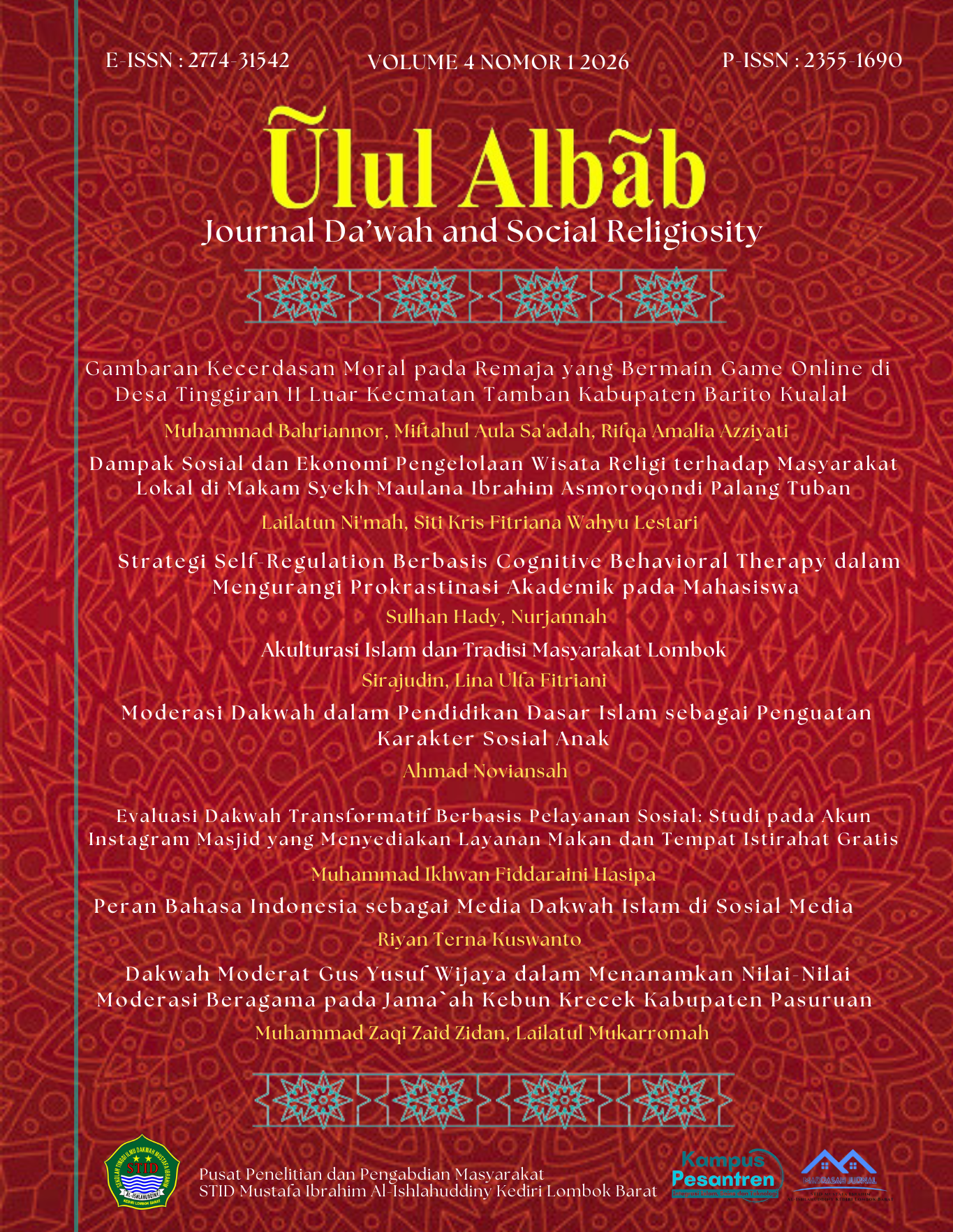
Peran Bahasa Indonesia sebagai Media Dakwah Islam di Sosial Media
DOI:
https://doi.org/10.69943/51a1fr43Keywords:
Indonesia, Digital Da'wah , Instagram, Millennial Generation, Islamic Social MediaAbstract
The development of social media, particularly Instagram, has opened up new spaces for the dissemination of Islamic da'wah messages in the digital era. This study aims to analyze the role of Indonesian as a medium for conveying Islamic da'wah on Instagram and identify the forms of Indonesian language use in digital da'wah content. The study used a descriptive qualitative approach with a case study method. Data were collected through observation of the content of Instagram da'wah accounts, interviews with two followers of the da'wah accounts, and documentation in June 2026. Data analysis was carried out through data reduction, data presentation, and drawing conclusions. The results show that Instagram functions dually as a communication medium and a da'wah medium. Da'wah content on this platform includes three forms: da'wah bil lisan (audio-visual sermons), bil qalam (captions and text), and bil hal (behavioral exemplars). The Indonesian language used varies from formal, semi-formal, to slang familiar to the millennial and Gen Z generations. Da'wah messages cover aspects of faith, sharia, and morals, delivered adaptively according to the platform's characteristics. Supporting factors include the large number of Instagram users, ease of access, and the appeal of visual content, while inhibiting factors include limited video duration and unequal internet access. This study concludes that Indonesian plays a strategic role in reaching young audiences inclusively and effectively. Digital preachers need to adopt innovative, adaptive, and responsive communication strategies to the dynamics of social media.
Downloads
Published
Issue
Section
License
Copyright (c) 2026 Ulul Albab: Jurnal Dakwah dan Sosial Keagamaan

This work is licensed under a Creative Commons Attribution-NonCommercial 4.0 International License.